Showing posts with label ventilation. Show all posts

Tuesday, December 11, 2012

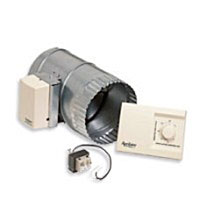
Product Feature: Aprilaire Model 8126 Ventilation Control System


Get state-of-the-art control to keep your indoor air as fresh as possible. Installed as part of your home’s heating and cooling system, the Aprilaire Ventilation Controller makes decisions regarding when—and how long—to ventilate. It does this through continuous montinoring of indoor relative humdity, outdoor temperature, and user-friendly settings.

Features
An Aprilaire Ventilation Control System allows you to manage the quality of your home’s air year-round, with little effort. An Aprilaire Ventilation Controller:
  • Will not ventilate if the outdoor temperature is above 100° F
  • Will not ventilate if the outdoor temperature is below 0° F
  • Only ventilates if a call for heat is received by your central heating system when the outdoor temperature is between 0° F and 20°
  • Will not ventilate if the outdoor air will raise indoor relative humidity above 55%
  • Has cycle times ranging from every one to four hours, with ventilation times lasting from zero to sixty minutes.
Choosing the right ventilation system is an important decision and investment.

Tuesday, September 18, 2012

Ventilation Improvements - A Guide to Indoor Air Quality, Part Nine

Welcome back to our Guide to Indoor Air Quality series. Last time, we talked about controlling the sources of indoor air pollutants. Time for part nine...

Ventilation Improvements

The second approach to lowering the concentrations of indoor air pollutants in your home is to increase the amount of outdoor air coming indoors. Most home heating and cooling systems, including forced air heating systems, do not mechanically bring fresh air into the house. Opening windows and doors, operating window or attic fans, when the weather permits, or running a window air conditioner with the vent control open increases the outdoor ventilation rate.

Local bathroom or kitchen fans that exhaust outdoors remove contaminants directly from the room where the fan is located and also increase the outdoor air ventilation rate. It is particularly important to take as many of these steps as possible while you are involved in short-term activities that can generate high levels of pollutants - for example: painting, paint stripping, heating with kerosene heaters, cooking, or engaging in maintenance and hobby activities such as welding, soldering, or sanding. You might also choose to do some of these activities outdoors, if you can and if weather permits.

Advanced designs of new homes are starting to feature mechanical systems that bring outdoor air into the home. Some of these designs include energy-efficient heat recovery ventilators (also known as air-to-air heat exchangers). For more information about air-to-air heat exchangers, contact the Conservation and Renewable Energy Inquiry and Referral Service (CAREIRS), PO Box 3048, Merrifield, VA 22116; (800) 523-2929.

Next in this series... Air Cleaners.


*Content provided by the Consumer Product Safety Commission and the Environmental Protection Agency. CPSC Document #450. This document is public domain.*

Thursday, August 16, 2012

Product Feature: Honeywell TrueFRESH™ Ventilation System

  • Year-round ventilation - brings fresh air into the home, even when windows are closed
  • Efficient Ventilation - Recovers up to 80% of the air leaving the home
  • Energy Efficient Operation - Uses about the same amount of energy as a 100-watt light bulb
  • HRV - Helps reduce window condensation and excess moisture during the winter
  • ERV - Helps reduce the amount of humidity brought into the home in the summer and retains humidity in the winter
  • Models - VNT5150H, VNT5200H, VNT5150E, VNT5200E
  • 5-Year Warranty

Tuesday, July 17, 2012

How Does Outdoor Air Enter a House? - A Guide to Indoor Air Quality, Part Two

Welcome back to our Guide to Indoor Air Quality series! Last time, we talked about the causes indoor air problems. Now, it's time for part two...

So, How Does Outdoor Air Enter a House?

Outdoor air enters and leaves a house by: infiltration, natural ventilation, and mechanical ventilation.

In a process known as infiltration, outdoor air flows into the house through openings, joints, and cracks in walls, floors, and ceilings, and around windows and doors.

In natural ventilation, air moves through opened windows and doors. Air movement associated with infiltration and natural ventilation is caused by air temperature differences between indoors and outdoors and by wind.

Finally, there are a number of mechanical ventilation devices, from outdoor-vented fans that intermittently remove air from a single room, such as bathrooms and kitchen, to air handling systems that use fans and duct work to continuously remove indoor air and distribute filtered and conditioned outdoor air to strategic points throughout the house.

The rate at which outdoor air replaces indoor air is described as the air exchange rate. When there is little infiltration, natural ventilation, or mechanical ventilation, the air exchange rate is low and pollutant levels can increase.

Next in this series... What if You Live in an Apartment?


*Content provided by the Consumer Product Safety Commission and the Environmental Protection Agency. CPSC Document #450. This document is public domain.*
Tuesday, July 3, 2012

What Causes Indoor Air Problems? - A Guide to Indoor Air Quality, Part One

All of us face a variety of risks to our health as we go about our day-to-day lives. Indoor air pollution is one risk you can do something about. In the last several years, a growing body of scientific evidence has indicated that the air within homes and other buildings can be more seriously polluted than the outdoor air in even the largest and most industrialized cities. Other research indicates that people spend approximately 90 percent of their time indoors. Thus, for many people, the risks to health may be greater due to exposure to air pollution indoors than outdoors.

In addition, people who may be exposed to indoor air pollutants for the longest periods of time are often those most susceptible to the effects of indoor air pollution. Such groups include the young, the elderly, and the chronically ill, especially those suffering from respiratory or cardiovascular disease.

So, What Causes Indoor Air Problems?

Indoor pollution sources that release gases or particles into the air are the primary cause of indoor air quality problems in homes. Inadequate ventilation can increase indoor pollutant levels by not bringing in enough outdoor air to dilute emissions from indoor sources and by not carrying indoor air pollutants out of the home. High temperature and humidity levels can also increase concentrations of some pollutants.

Pollutant Sources

There are many sources of indoor air pollution in any home. These include combustion sources such as oil, gas, kerosene, coal, wood, and tobacco products; building materials and furnishings as diverse as deteriorated, asbestos-containing insulation, wet or damp carpet, and cabinetry or furniture made of certain pressed wood products; products for household cleaning and maintenance, personal care, or hobbies; central heating and cooling systems and humidification devices; and outdoor sources such as radon, pesticides, and outdoor air pollution.

The relative importance of any single source depends on how much of a given pollutant it emits and how hazardous those emissions are. In some cases, factors such as how old the source is and whether it is properly maintained are significant. For example, an improperly adjusted gas stove can emit significantly more carbon monoxide than one that is properly adjusted. Some sources, such as building materials, furnishings, and household products like air fresheners, release pollutants more or less continuously.

Other sources, related to activities carried out in the home, release pollutants intermittently. These include smoking, the use of unvented or malfunction-ing stoves, furnaces, or space heaters, the use of solvents in cleaning and hobby activities, the use of paint strippers in redecorating activities, and the use of cleaning products and pesticides in housekeeping. High pollutant concentrations can remain in the air for long periods after some of these activities.

Amount of Ventilation

If too little outdoor air enters a home, pollutants can accumulate to levels that can pose health and comfort problems. Unless they are built with special mechanical means of ventilation, homes that are designed and constructed to minimize the amount of outdoor air that can "leak" into and out of the home may have higher pollutant levels than other homes. However, because some weather conditions can drastically reduce the amount of outdoor air that enters a home, pollutants can build up even in homes that are normally considered "leaky."

Next in this series... How Does Outdoor Air Enter a House?


*Content provided by the Consumer Product Safety Commission and the Environmental Protection Agency. CPSC Document #450. This document is public domain.*